
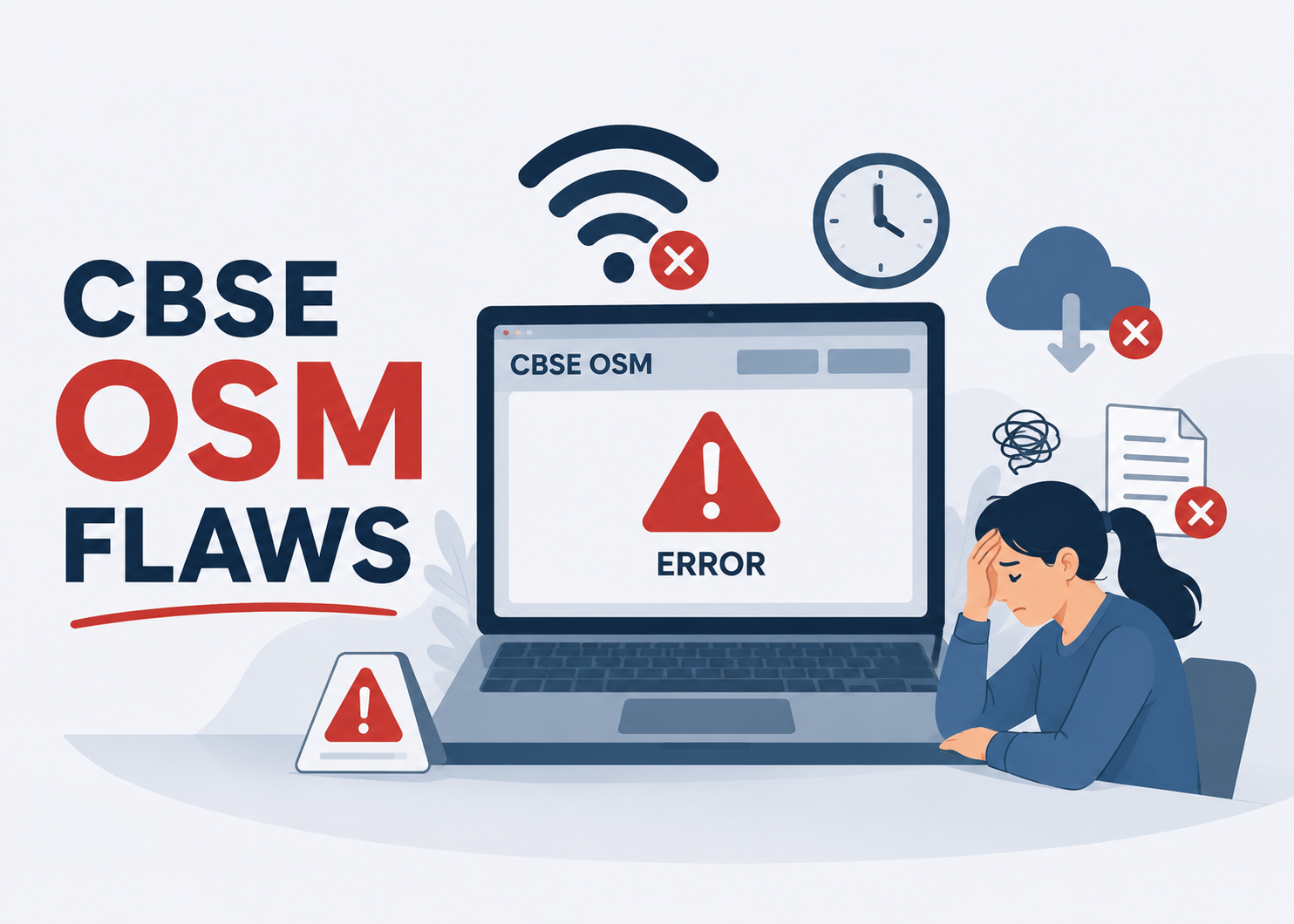
The Central Board of Secondary Education (CBSE) introduced online evaluation that is known as On-Screen Marking to make the marking process faster, more efficient, and transparent. While technology has helped reduce paperwork and speed up result processing, several concerns have emerged regarding the effectiveness and fairness of online marking. Unrest among students can be easily sensed throughout the country. Students are urging CBSE to reconsider this whole process and provide grace marks to them. Looking at these aspects therefore, CBSE should reconsider certain aspects of the online marking system and make necessary improvements.
Problems with Online Marking
1. Difficulty in Reading Handwriting
Many students have unclear handwriting. On a computer screen, it can be more difficult to read such answers compared to examining a physical answer sheet, increasing the possibility of marking errors. This can be clearly seen as many students have asked for their answer sheets and claimed so by uploading them on social media.
2. Technical Problems
Internet disruptions, software glitches, and system slowdowns can interrupt the evaluation process. These issues create frustration and may reduce the efficiency that online marking aims to achieve. Additionally teachers not being trained to performed such duties are also facing major issue in evaluation process.
3. Reduced Holistic Evaluation
Online systems often encourage evaluators to focus on individual scanned pages rather than the complete answer script. This may make it harder to assess the overall quality, flow, and presentation of a student’s work.
Suggested Solutions
1. Adopt a Hybrid Evaluation Model
CBSE can allow a combination of online and offline marking, especially for subjects requiring detailed evaluation, such as languages and humanities.
2. Improve Technology and Training
Providing better software, high-resolution scanned copies, and proper training for evaluators can help reduce mistakes and improve accuracy.
3. Strengthen Quality Checks
Random re-evaluation and moderation of answer sheets can help identify inconsistencies and ensure fair marking.
Conclusion
Online marking has many advantages, but it also presents challenges that may affect the accuracy and fairness of evaluation. By adopting a balanced approach and addressing existing issues, CBSE can create a more reliable and student-friendly assessment system that benefits both teachers and learners.